The Money Scripts Keeping You Broke: Identify and Rewrite Yours
Most money problems are not only about math.
They are also about memory.
The way you save, spend, avoid, earn, give, borrow, or panic about money is often shaped by beliefs you learned years ago. Some came from your parents. Some came from stress. Some came from culture. Some came from watching people around you struggle or succeed.
These beliefs can become invisible rules.
Rules like:
Money is always stressful.
People with money are greedy.
I will never be good with money.
If I have money, I should spend it before it disappears.
Debt is normal, so there is no point fighting it.
In financial psychology, these hidden beliefs are often called money scripts.
Understanding money scripts financial psychology can help you see why budgeting, saving, and debt payoff sometimes feel harder than they should. Your financial behavior may not be random. It may be following a script you did not realize you had.
The good news is that scripts can be rewritten.
This article will help you identify common money scripts, understand how they affect your financial life, and start replacing them with beliefs that support better decisions.
What Are Money Scripts?

Money scripts are deeply held beliefs about money that influence financial behavior.
They often develop early in life and become automatic. You may not even notice them until they show up in your spending, saving, investing, or debt habits.
For example, someone who grew up with financial instability may feel anxious whenever money sits in a checking account. Another person may spend quickly because they learned that money never lasts anyway. Someone else may avoid checking their bank account because money always felt connected to conflict or shame.
Money scripts are not always logical.
But they are powerful.
They can influence:
- How much you save
- How comfortable you feel earning more
- Whether you avoid money conversations
- How you use credit cards
- Whether you invest
- Whether you feel guilt spending on yourself
- Whether you overspend to feel successful
- Whether you undercharge for your work
The point is not to blame your past.
The point is to understand the pattern so you can change it.
Why Money Scripts Matter
A budget can show you what you spent.
A money script can help explain why you spent it.
That difference matters.
If your budget says you overspent on shopping, the surface solution is to spend less. But the deeper question might be:
- Was I trying to feel in control?
- Was I rewarding myself after stress?
- Was I trying to look successful?
- Was I avoiding a bigger money problem?
- Was I repeating a belief that money should be enjoyed immediately?
This is why money scripts financial psychology is useful. It connects behavior to belief.
When you understand the belief, you can create a better strategy.
For example, if your script is “I am bad with money,” another budgeting app alone may not fix the problem. You may also need small wins that prove you can manage money well.
If your script is “money is never safe,” building an emergency fund may feel emotionally uncomfortable, not just financially difficult.
If your script is “I deserve to spend because I work hard,” your budget needs room for guilt-free spending, not just restriction.
Money scripts matter because they shape the emotional side of financial decisions.
Money Script 1: “I’m Just Bad With Money”
This is one of the most damaging money scripts.
When you believe you are bad with money, every mistake feels like proof.
A missed bill becomes proof. A credit card balance becomes proof. An overdraft becomes proof. A failed budget becomes proof.
Eventually, the belief becomes an identity.
And once money failure feels like part of who you are, it becomes harder to change.
How This Script Hurts You
This script can lead to avoidance. You may stop checking accounts, ignore bills, delay budgeting, or assume there is no point trying.
It can also make you quit too early.
If your first budget does not work, you may think, “See? I knew I couldn’t do this.”
But budgeting is a skill. Saving is a skill. Planning is a skill. Skills improve with practice.
Rewrite the Script
Replace:
“I’m bad with money.”
With:
“I am learning how to manage money better one decision at a time.”
Then prove it with one small action: check your balance, pay one bill, create one category, or move $10 to savings.
Small proof breaks old scripts.
Money Script 2: “Money Is Meant to Be Spent”
This script often comes from scarcity.
If money disappeared quickly in your household, saving may not feel natural. Spending might feel like the only way to enjoy money before something else takes it.
This script can also come from emotional reward.
You work hard, feel stressed, and spending becomes the easiest way to feel relief.
How This Script Hurts You
This belief can keep you trapped in a cycle where income rises but savings never grow.
Every raise becomes a lifestyle upgrade. Every bonus disappears. Every extra dollar gets absorbed by the month.
Rewrite the Script
Replace:
“Money is meant to be spent.”
With:
“Some money is for today, and some money is for future me.”
This rewrite matters because it does not shame spending.
You are allowed to enjoy your money. But future you deserves support too.
Money Script 3: “Debt Is Normal”
In many households, debt feels like part of life.
Car payments, credit cards, financing plans, buy-now-pay-later purchases, and personal loans can become so common that debt starts to feel unavoidable.
But normal does not always mean harmless.
How This Script Hurts You
When debt feels normal, you may stop questioning it.
Instead of asking, “Can I afford this?” you ask, “Can I afford the payment?”
That shift can quietly damage your financial life.
Monthly payments reduce flexibility. Interest makes purchases more expensive. Debt can delay saving, investing, and building security.
Rewrite the Script
Replace:
“Debt is normal.”
With:
“Debt is a tool, but I choose when and why to use it.”
This gives you back control.
Not all debt is the same. But all debt deserves a decision.
Money Script 4: “Rich People Are Greedy”
Some people grow up hearing that money changes people, rich people are selfish, or wanting more money is morally wrong.
This script can create a strange conflict.
You may want financial security, but also feel uncomfortable earning, saving, investing, or building wealth.
How This Script Hurts You
If you associate money with greed, you may under-earn, avoid negotiating, feel guilty saving, or sabotage opportunities.
You may also struggle to imagine yourself as someone who can build wealth ethically.
Rewrite the Script
Replace:
“Rich people are greedy.”
With:
“Money reflects choices, and I can use money in alignment with my values.”
Money can amplify greed.
But it can also support generosity, stability, freedom, family, creativity, and impact.
The goal is not to worship money.
The goal is to use it intentionally.
Money Script 5: “I Don’t Deserve Money”
This script can be quiet, but powerful.
It may show up as undercharging, avoiding raises, feeling guilty about success, or spending money quickly because keeping it feels uncomfortable.
Some people feel they must struggle to be worthy. Others feel guilty doing better than family or friends.
How This Script Hurts You
This belief can limit income and savings.
You may reject opportunities, avoid investing in yourself, or feel uncomfortable building security.
Rewrite the Script
Replace:
“I don’t deserve money.”
With:
“I am allowed to build stability, receive fair pay, and use money responsibly.”
You do not have to earn financial peace through suffering.
You are allowed to build a calmer life.
Money Script 6: “If I Ignore It, It Will Work Out”
Avoidance is one of the most common money behaviors.
It can feel easier not to look.
Do not open the bill. Do not check the balance. Do not calculate the debt. Do not look at retirement. Do not talk about money.
But avoidance does not remove the problem.
It only removes your ability to respond early.
How This Script Hurts You
Avoidance can lead to late fees, overdrafts, missed payments, growing debt, and more stress.
It also makes money feel scarier over time.
The longer you avoid it, the bigger the emotional wall becomes.
Rewrite the Script
Replace:
“If I ignore it, it will work out.”
With:
“Looking at my money gives me more options.”
Start small. Set a five-minute money check-in. Look at one account. Open one bill. Review one category.
Clarity reduces fear.
Money Script 7: “I’ll Start When I Make More Money”
This script sounds reasonable.
More income can absolutely help. But waiting for more money before building better habits can delay progress for years.
If every financial habit depends on a future raise, today’s money remains unmanaged.
How This Script Hurts You
When income increases without a system, expenses often increase too.
This is lifestyle creep.
A person can go from $40,000 to $80,000 and still feel broke if every raise gets absorbed by bigger payments, more subscriptions, nicer restaurants, and upgraded expectations.
Rewrite the Script
Replace:
“I’ll start when I make more money.”
With:
“I can practice with the money I have now.”
Even small habits matter.
Save $10. Track one category. Pay $25 extra toward debt. Start a beginner budget.
The amount may be small, but the identity shift is big.
How to Identify Your Money Script
You can start by noticing emotional reactions.
Ask yourself:
- What money topic makes me feel anxious?
- What financial task do I avoid?
- What do I believe about people who have money?
- What did I hear about money growing up?
- When I receive extra money, what do I usually do first?
- What purchase patterns keep repeating?
- What financial goal feels uncomfortable?
Then complete these sentences:
- Money is ________.
- People with money are ________.
- I am the kind of person who ________ with money.
- Saving money feels ________.
- Debt is ________.
- Earning more money would mean ________.
Your answers may reveal the script underneath the behavior.
Do not judge the answer. Just notice it.
Awareness is the first rewrite.
How to Rewrite a Money Script
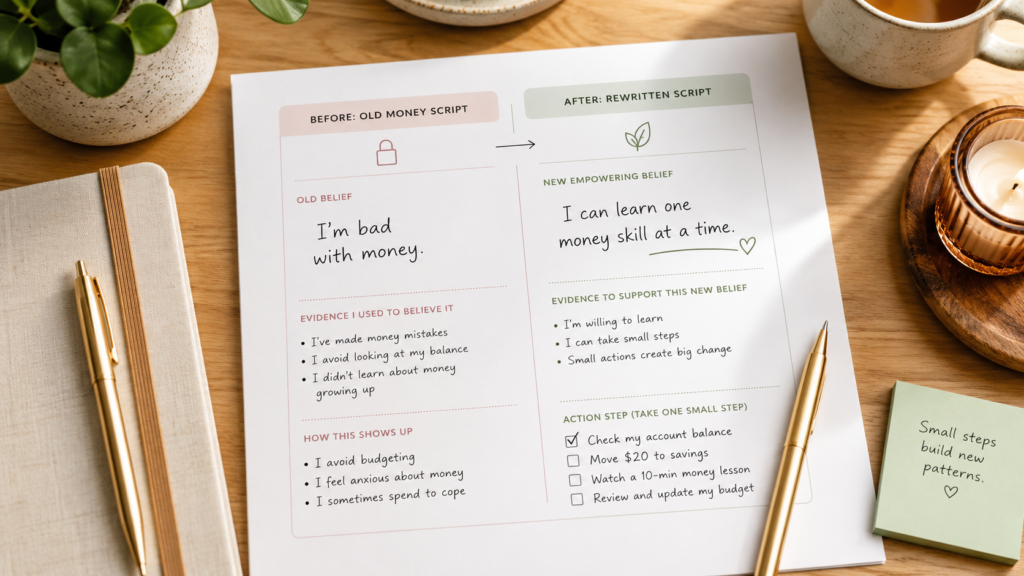
Rewriting a money script takes more than repeating a positive phrase.
You need a new belief and new evidence.
Use this simple process.
Step 1: Name the Old Script
Write the belief clearly.
Example:
“I am bad with money.”
Step 2: Find Where It Came From
Ask where you learned it.
Was it from family? Stress? Debt? Past mistakes? Culture? A specific experience?
Understanding the origin helps separate the belief from your identity.
Step 3: Create a More Useful Belief
Do not choose something fake.
Choose something believable.
Instead of “I am amazing with money,” try:
“I can learn one money skill at a time.”
Step 4: Take One Small Action
New beliefs need proof.
Examples:
- Check your balance
- Create a budget category
- Cancel one unused subscription
- Transfer $10 to savings
- Pay one bill early
- Ask for a lower rate
- Review one week of spending
Step 5: Repeat Until the New Script Feels Normal
You do not rewrite years of beliefs in one day.
But every repeated action creates new evidence.
Eventually, your brain stops seeing money as a threat and starts seeing it as something you can manage.
The Bottom Line
Your financial life is shaped by more than income and expenses.
It is shaped by the stories you believe about money.
Some stories protect you. Some stories limit you. Some stories helped you survive the past but no longer serve your future.
That is why money scripts financial psychology matters.
When you identify your money scripts, you stop treating every financial mistake like a character flaw. You start seeing patterns. And once you see the pattern, you can change the system.
You are not stuck with the first money story you learned.
You can rewrite it.
One belief. One decision. One small financial win at a time.
Quick Takeaways
- Money scripts are hidden beliefs about money that influence financial behavior.
- Common money scripts include “I’m bad with money,” “money is meant to be spent,” and “I’ll start when I make more money.”
- Money scripts often come from childhood, culture, stress, or past financial experiences.
- Rewriting a money script requires a new belief and small actions that create new proof.
- Better financial habits often start with understanding the emotional story behind the behavior.
Why Budgets Fail Even When You Try Hard
7 Steps to Zero-Based Budgeting for Beginners
Useful resources: Overview from Dr. Brad Klontz on money scripts