How to Build a 3-Month Emergency Fund on a Tight Budget
An emergency fund sounds simple until you are trying to build one while every dollar already has somewhere to go.
Rent is due. Groceries are expensive. Gas changes every week. A subscription renews. A school fee appears. A small car repair turns into a credit card balance. When money is tight, saving three months of expenses can feel unrealistic, almost like advice written for someone with a completely different life.
But a three-month emergency fund is not built in one perfect month. It is built one layer at a time.
If you want to know how to build emergency fund fast, the answer is not usually a dramatic money challenge or a week of extreme restriction. The answer is to make the first target smaller, make the transfer automatic, separate the money from daily spending, and create rules that protect the fund once it starts growing.
The goal is not to become financially perfect overnight. The goal is to create distance between you and the next emergency. Even a small emergency fund can change how you respond to stress. A $500 cushion can keep a tire repair off a credit card. A $1,000 cushion can make a medical bill less frightening. One month of essential expenses can turn a layoff from immediate panic into a problem you have time to manage.
This guide will show you how to build a three-month emergency fund even when your budget feels tight, how to calculate the right target, how to find savings without making your life miserable, and how to keep the fund protected once you have it.
What Is an Emergency Fund?
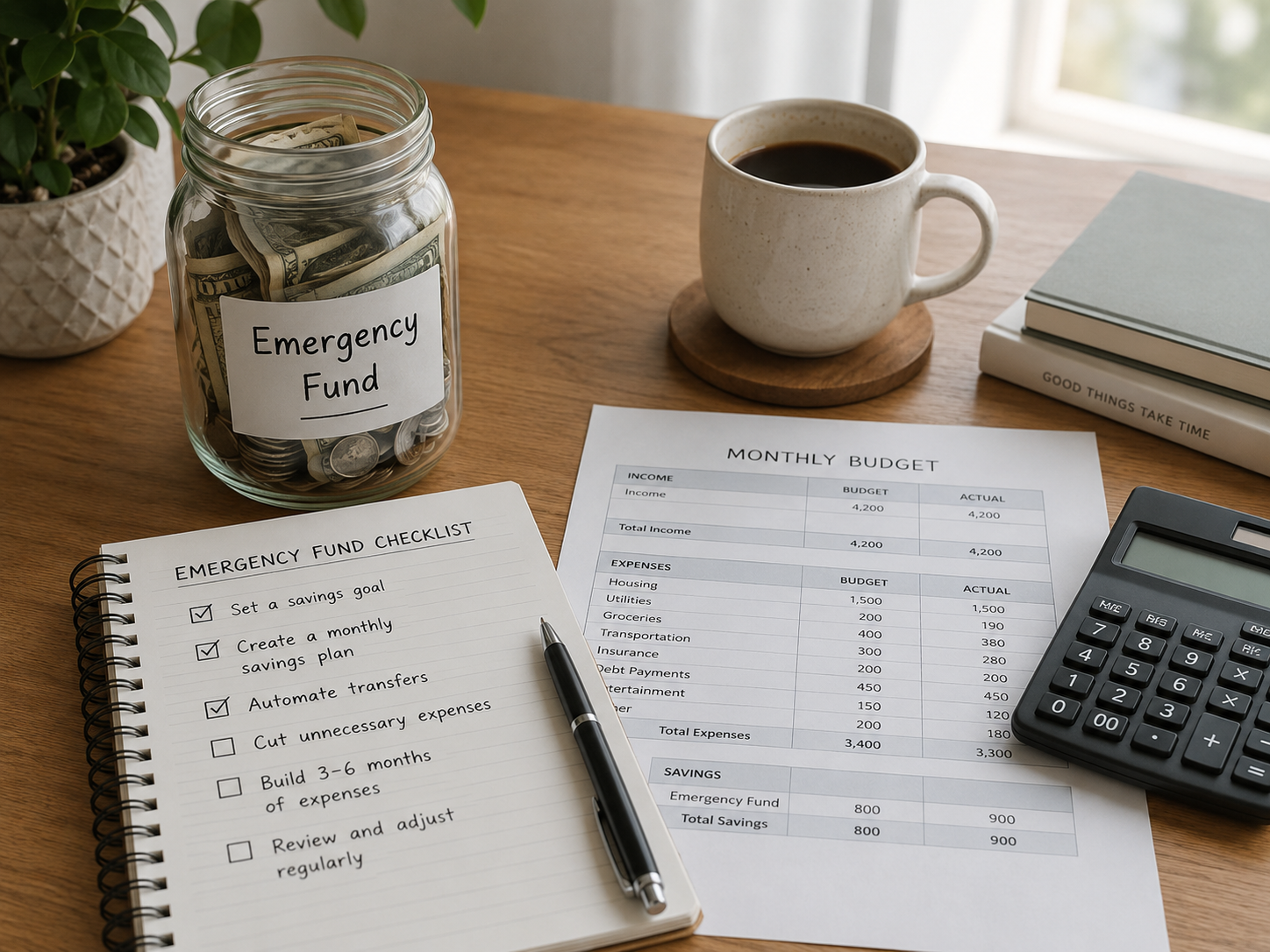
An emergency fund is money set aside for unexpected but necessary expenses. It is not vacation money. It is not shopping money. It is not a general savings account that gets used whenever the month feels inconvenient.
An emergency fund is financial protection.
It exists for situations like income loss, urgent car repairs, medical bills, essential home repairs, emergency travel, or a sudden family need. The key words are unexpected, necessary, and time-sensitive.
This is important because many people technically have savings, but the money has no clear purpose. It becomes a mix of emergency money, holiday money, vacation money, car repair money, and “maybe I will use this later” money. When savings has no boundaries, it is easier to spend it casually and harder to know whether you are actually protected.
A real emergency fund should be separate from regular spending and separate from planned savings goals. If you know your car registration is due every year, that is not an emergency. It belongs in a sinking fund. If you know the holidays are coming, that is not an emergency. It belongs in a gift fund. If you want a weekend trip, that is not an emergency. It belongs in a travel fund.
The emergency fund is for the things you could not reasonably schedule but still must pay for.
The Consumer Financial Protection Bureau explains that an emergency fund is money set aside for unexpected expenses or emergencies, which is why it should be kept separate from everyday spending.
Why Three Months?
A common recommendation is to save three to six months of expenses. That number can be helpful, but it can also feel discouraging. If your essential monthly expenses are $3,000, three months means $9,000. If your household needs $5,000 per month, three months means $15,000.
Those numbers are not small.
But the three-month target exists for a reason. It gives you time. If income drops, you can pay rent, buy groceries, keep insurance active, stay current on minimum debt payments, and avoid making desperate decisions while you look for a new job or solve the emergency.
The key is that three months does not mean three months of your full lifestyle. It means three months of essential expenses.
You do not need to save enough for restaurants, subscriptions, shopping, entertainment, travel, and extras during a crisis. In a true emergency, you would likely reduce or pause those categories. Your emergency fund should cover the basics that keep your life stable.
Essential expenses usually include housing, utilities, groceries, transportation, insurance, medication, minimum debt payments, childcare, and other required family obligations. Once you calculate that number, the goal becomes more realistic.
For example, maybe your normal monthly spending is $4,500, but your essential expenses are $3,100. Your three-month emergency fund target would be $9,300, not $13,500. That difference matters.
Step 1: Start With a Starter Emergency Fund
The biggest mistake is waiting until you can save the full three-month amount.
If your final goal is $9,000, it is easy to feel like $50 does not matter. But it does matter. Every dollar saved is one dollar that does not have to come from a credit card, payday loan, overdraft, or borrowed money from family.
Start with a starter emergency fund.
A good beginner target is $500 to $1,000. If your income is very tight, start with $250. If you have kids, pets, an older car, or variable income, try to reach $1,000 as quickly as possible.
This first layer is not meant to solve every emergency. It is meant to stop the small ones from becoming bigger financial problems.
A starter fund can cover a minor repair, urgent prescription, school expense, small medical bill, or a missed paycheck gap. It gives your budget breathing room.
To build it quickly, look for short-term moves that do not need to last forever. Sell unused items. Pause one nonessential subscription. Skip one delivery order per week. Send any refund, cash-back reward, or small bonus directly to savings. Use a temporary no-spend weekend. Pick up one small side task if that is realistic.
Do not make the plan so extreme that you quit after one week. The goal is momentum.
Step 2: Calculate Your Real Three-Month Target
Once your starter fund is in motion, calculate the real goal.
Write down your essential monthly expenses. Do not guess. Use your bank statements, card statements, and bills from the last one to three months.
Include:
- Rent or mortgage
- Utilities
- Groceries
- Gas or required transportation
- Insurance
- Minimum debt payments
- Medication and essential healthcare
- Childcare
- Phone and internet if needed for work or family
- Required family support
Exclude:
- Restaurants
- Entertainment
- Subscriptions you could pause
- Shopping
- Travel
- Hobbies
- Extra debt payments above the minimum
- Nonessential upgrades
Here is an example:
| Essential Category | Monthly Amount |
|—|—:|
| Rent | $1,600 |
| Utilities | $300 |
| Groceries | $600 |
| Transportation | $250 |
| Insurance | $220 |
| Minimum debt payments | $300 |
| Phone and internet | $150 |
| Medication | $80 |
| Total essential expenses | $3,500 |
In this example, one month of essentials is $3,500. A three-month emergency fund is $10,500.
That number may still feel large, but now it is specific. Specific goals are easier to plan for than vague goals.
Step 3: Build the Fund in Milestones
Do not stare only at the final number. Break it into milestones.
A three-month emergency fund can be built like a ladder:
- Milestone 1: $250
- Milestone 2: $500
- Milestone 3: $1,000
- Milestone 4: One month of essential expenses
- Milestone 5: Two months of essential expenses
- Milestone 6: Three months of essential expenses
This matters psychologically. If your only goal is $10,500, you may feel behind for months or years. But if your next goal is $500, you can win quickly. Then the next win is $1,000. Then one month.
Each milestone gives you more protection.
At $500, you can handle many small emergencies.
At $1,000, you can handle bigger surprises.
At one month, you can survive a short income disruption.
At three months, you have serious breathing room.
Financial confidence grows when you can see progress.
Step 4: Treat Emergency Savings Like a Bill
If emergency savings waits until the end of the month, it will usually lose.
There is always something else. Food, gas, a birthday, a sale, a school event, a repair, a fee, a subscription, or a random purchase that seemed small at the time.
That is why emergency savings should be planned at the beginning of the month or immediately after payday.
Treat it like a bill you owe your future self.
This does not mean the amount has to be large. It means the habit has to be consistent. You can start with $10 per paycheck. Then $25. Then $50. If your income improves or debt decreases, increase the transfer.
Small transfers add up:
| Weekly Transfer | One-Year Total |
|—|—:|
| $10/week | $520 |
| $25/week | $1,300 |
| $50/week | $2,600 |
| $75/week | $3,900 |
| $100/week | $5,200 |
Many people underestimate small savings because they do not feel exciting. But emergency funds are built through repetition, not excitement.
Step 5: Keep the Money Separate
Your emergency fund should not sit inside the same checking account you use for groceries, bills, and everyday spending.
When all money is mixed together, it is easy to accidentally spend money you meant to save. You may look at your balance, feel like you have extra, and make a purchase that quietly weakens your safety net.
Use a separate savings account if possible. A high-yield savings account can be a good option because the money can earn some interest while still staying accessible. The account should be easy enough to reach in a real emergency, but not so easy that you use it for every small impulse.
Avoid putting emergency money into risky investments. Your emergency fund is not there to maximize returns. It is there to be stable, liquid, and available.
A simple rule works well:
Checking is for this month. Emergency savings is for a real crisis. Sinking funds are for predictable future costs.
When every account has a purpose, your money becomes easier to manage.
Step 6: Find Money Without Cutting Everything You Enjoy
A tight budget does not mean you have to remove every enjoyable thing from your life. In fact, a budget with no room for joy often fails.
The better strategy is to look for low-value spending before cutting high-value spending.
Low-value spending is money that leaves your account but does not improve your life much. It may be an unused subscription, extra delivery fees, random convenience purchases, duplicate services, impulse shopping, or groceries that go bad because there was no meal plan.
Start with a spending review. Look at the last 30 days and ask:
- What did I buy but barely use?
- Which subscriptions did I forget about?
- Which purchases were stress reactions?
- Which categories surprised me?
- What spending would I not miss if it disappeared?
Then pick one or two changes.
You might reduce delivery from three times a week to one. You might plan two easy dinners at home. You might cancel a subscription and move the exact amount to emergency savings. You might use a grocery list before shopping. You might set a 24-hour rule for purchases over $50.
The goal is not deprivation. The goal is redirecting money from forgettable spending to financial safety.
Step 7: Use Sinking Funds to Protect the Emergency Fund
One reason emergency funds disappear is that people use them for expenses that were predictable.
Car repairs are not always predictable in timing, but car maintenance is predictable as a category. Holidays are predictable. Annual subscriptions are predictable. School expenses are predictable. Pet care is predictable. Medical visits may not be exact, but healthcare costs are predictable enough to plan for.
If you use your emergency fund for every predictable expense, it will never stay built.
That is where sinking funds help.
A sinking fund is money saved gradually for a known future cost. For example, if you expect to spend $900 on car maintenance this year, save $75 per month. If holiday gifts usually cost $600, save $50 per month. If annual subscriptions cost $240, save $20 per month.
Your emergency fund should be the last line of defense. Sinking funds are the first line of preparation.
This is one of the most important differences between people who build lasting savings and people who keep restarting. They do not just save for emergencies. They also save for the predictable expenses that used to feel like emergencies.
Step 8: Know What Counts as an Emergency
Rules protect your emergency fund from emotional decisions.
Before you need the money, define what qualifies.
A real emergency might include:
- Job loss or reduced income
- Urgent medical or dental need
- Necessary car repair
- Essential home repair
- Emergency travel for a family crisis
- A required bill you cannot delay without serious consequences
Not emergencies:
- A sale
- A vacation
- Holiday gifts
- Routine car maintenance
- Annual subscriptions
- A nicer phone
- A restaurant week
- Planned school costs
This does not mean those things are bad. It means they need their own categories.
When you define emergencies ahead of time, you reduce guilt and confusion. If the situation fits the rules, use the fund. If it does not, pause and find another category.
Step 9: Refill the Fund After Using It
Using your emergency fund is not failure. It is success. The fund did its job.
The only mistake is using it and never rebuilding it.
After an emergency, make refilling the fund your temporary priority. You may pause extra debt payments for a short time, reduce fun money, delay a nonessential purchase, or send extra income to savings until the balance is restored.
Think of the emergency fund like a shield. When it takes a hit, you repair it.
This mindset matters because some people feel discouraged after using savings. They think they are back at zero. But without the emergency fund, the same situation might have become debt. The fund protected you, and now you rebuild.
A Simple 3-Month Emergency Fund Plan
Here is a realistic plan for someone whose essential expenses are $3,000 per month and whose full target is $9,000.
Month 1: Save $500 starter fund.
Month 2: Build to $1,000.
Month 3 to 8: Save $350 per month until reaching about one month of essentials.
Month 9 to 16: Increase to $400 or $500 per month if possible, using raises, refunds, or reduced debt payments.
Month 17 and beyond: Continue until reaching three months.
Your timeline may be faster or slower. That is fine. The point is not to match someone else’s pace. The point is to keep building.
If your income is inconsistent, save by percentage instead of fixed amount. For example, save 5% of every paycheck, then 10% of any unusually strong month. Variable income needs flexible rules, not wishful thinking.
Common Emergency Fund Mistakes
The first mistake is setting the target so high that you never start. Start small.
The second mistake is keeping the fund in checking. Separate it.
The third mistake is using emergency savings for predictable expenses. Create sinking funds.
The fourth mistake is stopping after $1,000 when your household risk is higher. A starter fund is not the final goal.
The fifth mistake is investing emergency money. Emergency funds need stability, not risk.
The sixth mistake is judging yourself for needing the fund. Emergencies are the reason the fund exists.
Avoiding these mistakes can make your emergency fund stronger and easier to maintain.
The Bottom Line
Building a three-month emergency fund on a tight budget is not about saving thousands of dollars overnight. It is about building a system that can survive real life.
Start with a starter fund. Calculate your real essential expenses. Break the goal into milestones. Automate small transfers. Keep the money separate. Protect it with sinking funds. Define emergencies before they happen. Refill the fund when you use it.
If you want to know how to build emergency fund fast, start by building it consistently. Fast does not always mean dramatic. Sometimes fast means removing the friction, making the habit automatic, and refusing to restart from zero every time life gets expensive.
Your emergency fund is not just money.
It is time.
It is options.
It is calm.
It is the space between a surprise and a crisis.
Quick Takeaways
- Start with a $500 to $1,000 starter emergency fund before aiming for three months.
- A full emergency fund should cover essential expenses, not your full lifestyle.
- Automate savings on payday, even if the amount is small.
- Keep emergency money separate from daily checking.
- Use sinking funds for predictable expenses so your emergency fund stays protected.
- Define what counts as an emergency before emotions get involved.